Jesus begins with a severe warning: “Woe to the one who causes others to stumble. It would be better for him to have a millstone hung around his neck and be thrown into the sea.” He immediately follows with a demanding command: “If your brother sins, rebuke him. If he repents, forgive him.”
At first glance, these two statements feel disconnected—judgment and forgiveness, severity and mercy. The disciples seem to feel the weight of this tension, because their response is unexpected: “Increase our faith!” That request appears just as disconnected as the statements that prompted it.
Jesus’ reply is even more surprising. Instead of praying for their faith to grow, he tells a brief parable: “If you had faith the size of a mustard seed, you could say to this mulberry tree, ‘Be uprooted and planted in the sea,’ and it would obey you.” Then, without pause, he speaks of servants and obedience: no master thanks a servant for doing what was commanded; the servant simply does his duty. Jesus concludes, “So you also, when you have done everything you were commanded, say, ‘We are unworthy servants; we have only done what was our duty.’”
What ties all of this together?
Several themes repeat: the sea, faith, obedience, and worthiness. When the disciples ask for more faith, Jesus reframes the issue entirely. His point is not that they lack faith, but that they misunderstand it. Even the smallest amount of genuine faith is sufficient for obedience. The problem is not the quantity of faith but the exercise of it.
Jesus is not promising spectacular miracles as proof of faith; he is exposing a misconception. The disciples seem to believe that greater faith would make forgiveness easier, obedience lighter, and themselves more worthy. Jesus counters that assumption. Faith is not measured by outcomes, recognition, or spiritual power. Faith is demonstrated in obedience—especially when that obedience feels costly and unnoticed.
That is why Jesus immediately turns to the image of a servant. Obedience is not grounds for praise; it is the baseline expectation of discipleship. Forgiving a brother, refusing to become a stumbling block, and serving faithfully do not earn worthiness. They are simply what servants do.
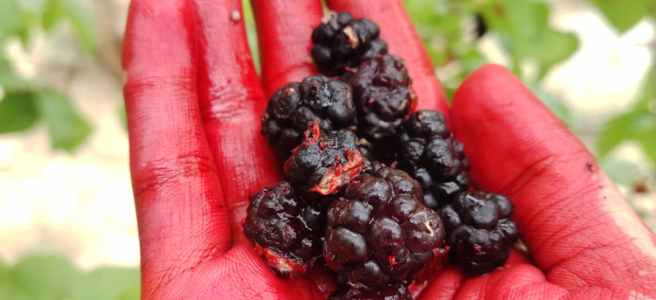
The mulberry tree itself may deepen the meaning. Rabbinic tradition associated the mulberry with Cain because its berries stain the hands red—an image of blood guilt that cannot be hidden. A brother whose hands are stained is a brother marked by jealousy, resentment, and violence of heart. Jesus is calling his disciples to forgive even that brother. To uproot a tree like that—to cast it into the sea where stumbling blocks belong—does not require great faith, only true faith expressed in obedience.
In the end, Jesus dismantles the disciples’ concern with size: the size of their faith, the size of their righteousness, the size of their worth. A tiny faith can uproot massive trees. But the real question is not whether they can command a tree—it is whether they can forgive a brother.
That kind of obedience may never be applauded. It may go unnoticed. But it is exactly what disciples of Christ are called to do.
written by Kim Blenkhorn
edited with the use of chatGBT

 My Faith Place